 PulseMove
Why gentle reminders lose to hyperfocus
Hyperfocus is a superpower with no exit ramp. Three hours disappear, your legs are asleep, you forgot to eat — and fourteen notifications sit unread in the shade. People with ADHD often describe two mechanics behind this:
- Time blindness. Without external markers, elapsed time simply doesn't register. “I'll get up in a minute” isn't a lie — the minute genuinely never announces itself.
- Interest-gated attention. The task in front of you is generating stimulation; a gray banner is not. It's not a fair fight, and the banner loses every time.
Add notification habituation — the same filtering every brain does — and a “gentle nudge” is functionally invisible by week two.
What actually interrupts (without wrecking the day)
The fix isn't more reminders; it's a different grade of reminder, used sparingly:
- Full takeover. A lock-screen alarm can't sit unread in a corner. It demands a decision the way a morning alarm does.
- A physical dismissal. Requiring ~25 walked steps converts “dismiss” from a half-second tap into an actual state change — posture, blood flow, context. The walk itself is the exit ramp from hyperfocus.
- Persistence. If it can be deferred forever, it will be. A re-ring every minute makes “later” a real decision instead of a default.
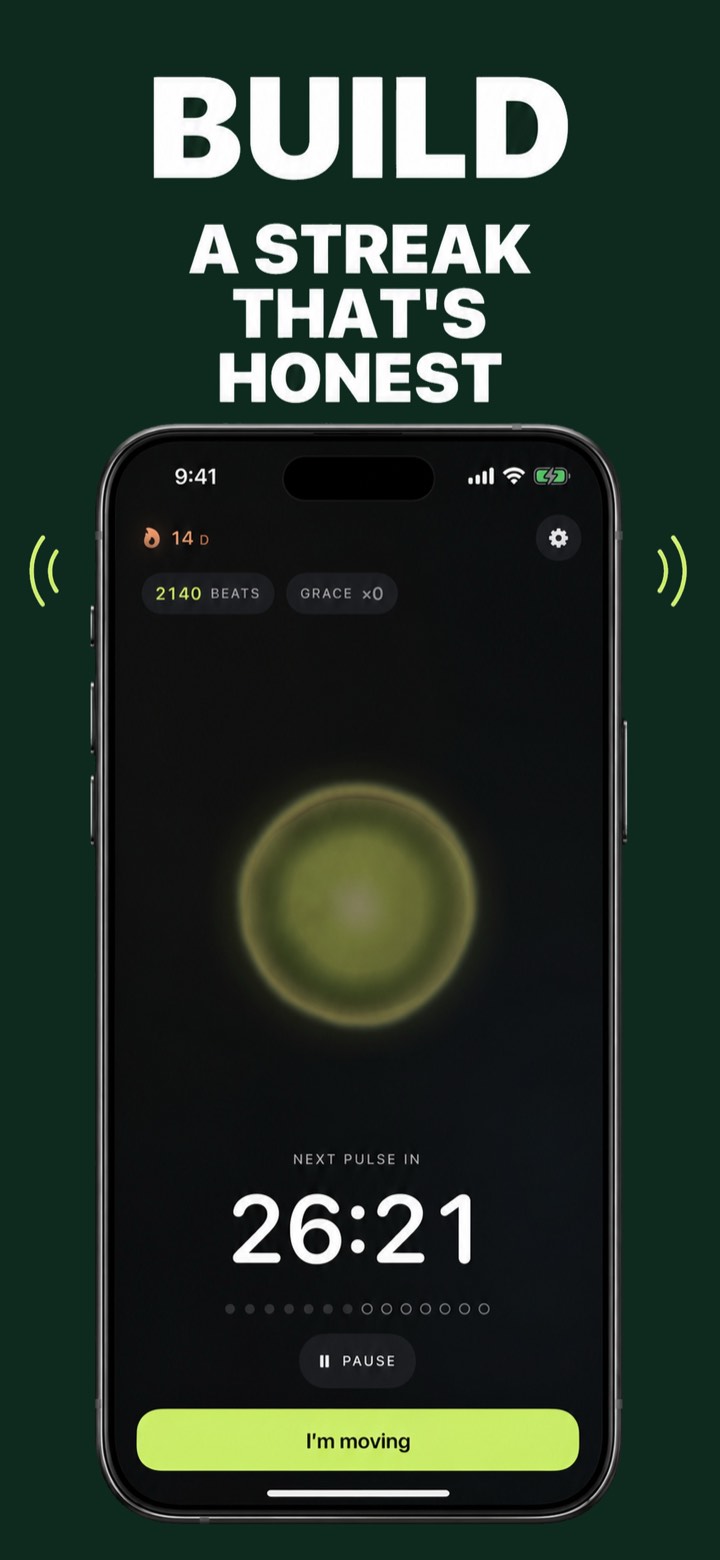
- Visible time. A countdown to the next pulse makes time external and concrete — a running answer to “how long have I been at this?”
Flexibility without the shame spiral
Rigid systems break ADHD users on the first bad day — and the broken streak becomes a reason to quit. PulseMove builds the flexibility in as game mechanics, not loopholes:
- Grace tokens. Mid-flow on something that matters? Spend 100 earned Beats to skip one pulse guilt-free — the day still counts, and moving later refunds the token.
- An 80% day, not a perfect day. Your streak counts when you resolve 80% of the day's pulses. One missed alarm doesn't torch the record.
- Streak repair. A genuinely bad day can be repaired — the system is designed for humans, not robots.
- Immediate rewards. Beats land the moment you move, with a bonus for moving within two minutes of the ring — fast feedback, the kind ADHD brains actually register.
Settings that work for ADHD brains
- Start at a 45–60 minute cadence. Aggressive intervals feel great on day one and unbearable on day four. Sustainable beats strict.
- Keep the window honest. Cover your real work hours, not an aspirational 6am start.
- Let the calendar do the negotiating. Meetings are skipped automatically, so the alarm never cries wolf.
- Use Grace deliberately. Two per day, max — that's the built-in ceiling, and it's enough.
PulseMove is a movement alarm, not a medical device or ADHD treatment — it's one external structure that many brains find easier to obey than a notification.
An external brain for movement
PulseMove takes over the lock screen, demands ~25 steps, and forgives bad days without faking good ones. Free for 3 days.
Get PulseMove — free trial